Tennessee Rock Hiking Trail
An overlook on the Tennessee Rock hiking trail in Black Rock Mountain State Park is on the Eastern Continental Divide. Rain that falls on the east side of the Divide flows into the Atlantic Ocean via the Savannah River; rain; that falls on the west side of the Divide flows into the Gulf of Mexico via the Chattahoochee and Apalachicola rivers.
TRAIL SUMMARY Location: Eastern Blue Ridge, Black Rock Mountain, Black Rock Mountain State Park; Features: View, diverse flora, excellent interpretive trail, Eastern Continental Divide; Distance: 2.2 miles (loop); Difficulty Rating: Modeerate; County: Rabun; Nearest City: Mountain City; Maps: Dillard Quad GA-NC, park map available at visitor center; Blazes: Yellow;
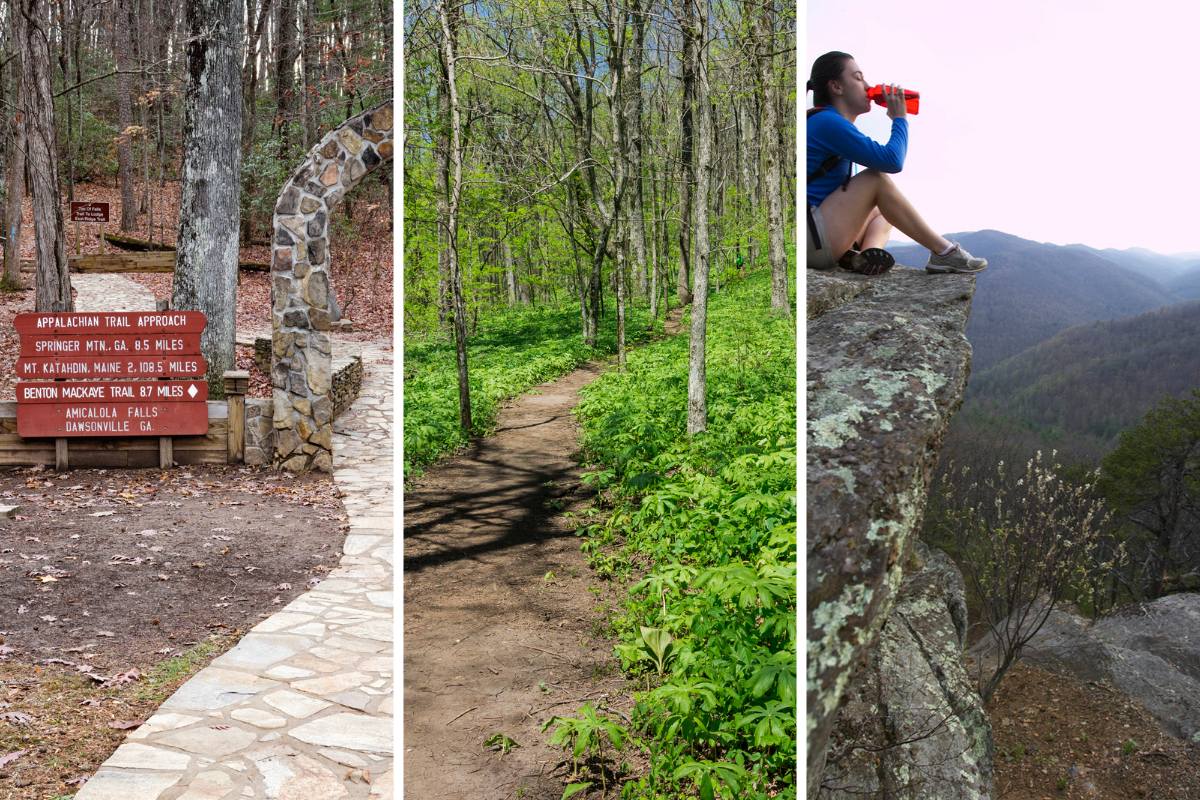
Tennessee Rock is one of the most varied and scenic state park trails. Anthony Lampros and Dustin Warner have recently developed twenty-five interpretive stations throughout its length; an excellent guide to the numbered posts is available at the visitor center for a small fee. Easily walked in an hour or two, its loop traverses the botanically rich slopes and ridge CIest of Black Rock Mountain. Flame azalea, mountain lauret and numerous species of wild- flowers bloom beside the path from mid-April through May.
The wide, yellow-blazed walkway begins with a short, moderate climb up wooden steps. After less than 100 yards, the trail reaches the point where its loop begins and ends. A sign states that the loop is easier to walk to the right} counterclockwise. This description follows that direction.
After turning right, the trail continues on an easy upgrade through a hardwood forest dominated by oaks. Beyond 0.2 mile the path becomes level or slightly descending as it winds along a slope that is alternately moist, then dry. Here the herb layer of the forest displays ferns and wildflowers including Virginia spiderwort, Canada violet, and mayapple. A sign marks the entrance of a 100-yard spur that leads to the base of a small boulder field at post 7.
The loop turns left onto an old road at 0.7 mile.
This road soon enters an extensive planting of white pine where pinesaps-saprophytic wildflowers-are abundant. These unusual plants do not produce chlorophyll and obtain their nourishment, with the aid of fungi, from organic matter. Most of the pinesaps in this colony were pale yellowish-orange rather than their more common coloration of reddish-orange. They bloom during the second half of July and early August.
A short distance after the road leaves the pine forest, the treadway turns left and becomes path again at mile 1.2. Here the trail makes a moderate-to-strenuous climb to the ridge of Black Rock Mountain. Once on the ridge, the footpath continues slightly uphill through an open deciduous forest. Several patches of starry campions - wiIdflowers identified by their five fringed, white petals and four whorled leaves-bloom along this section of the loop in late July and early August.
At mile 1.7 the trail climbs wooden steps over the first mound of the gneiss outcrop known as Tennessee Rock, which is part of the Eastern Continental Divide: a series of ridges that separate watersheds and their river systems. Water bouncing off the north side of the rock flows to the Gulf of Mexico, by way of the Tennessee, Ohio, and Mississippi Rivers. Raindrops splattering to the south of the rock contribute to the watersheds that flow to the Atlantic Ocean, by way of the Savannah River.
This narrow backbone crest of the mountain affords surprisingly scenic views of the Wolffork and Germany Valleys, and towns and mountains to either side. Beyond the look-off areas, the path drops to a road, then curls downhill and to the left away from the pavement. The trail's ending segment passes above a colony of Vasey's trillium. They usually flower from late April to late May.
Highlights
Throughout: Interpretive signs describing the features of the Southern
Appalachian forest. Also, a wide diversity of wildflowers.
Mile 1.7: Tennessee Rock Overlook (3,625 feet) and the Eastern Continental Divide.
Directions
From Clayton, take US 441 North to Mountain City. In Mountain
City, turn left onto Black Rock Mountain Road. A prominent sign marks
the turn.
The Tennessee Rock Trail begins along the road that leads to the cottages. Two-tenths mile beyond the fork in the main park road (camping to the left, cottages to the right), turn right into the large day-use play area parking lot. There are signs for Tennessee Rock Trail and James E. Edmonds Backcountry Trail at the back of the gravel lot.
Tagged with: Black Rock Mountain Eastern Continental Divide Eastern Blue Ridge Hiking Trails in Georgia
Related Listings
Black Rock Mountain State Park
Mountain City, GA, State ParksBlack Rock Mountain State Park, named for its sheer cliffs of dark granite, is the highest state park in the state.